Uncategorized Archives - Page 4 of 4 - Strada Healthcare

Time Health Transitions Members to Strada Healthcare

Strada Healthcare is Nebraska’s largest Direct Primary Care provider and is excited to announce that it recently reached an agreement with Time Health to transition Time Health members to Strada Healthcare. Members of Time Health have been notified of this change are welcome to choose from any of Strada Healthcare’s multiple locations in the greater-Omaha area to resume medical care.
These newest Strada Healthcare members will be given unlimited access to a provider of their choice for a monthly fee ranging from $49 to $99 per month. Nearly all primary care services are covered and Strada patients also have the ability to text or call their provider after-hours.
Here are some of the services covered with a Strada Healthcare membership:
    • Annual Physical
    • Preventative appointments and follow-ups
    • Annual lab work
    • EKG
    • Repair of simple cuts and abrasions (includes stitches)
    • Treatment of sprains
    • Women’s health
    • Well checks for infants
    • Weight management and health risk assessment
    • Stress management
    • Mental Health, including treatment for depression, anxiety and other mood disorders.
    • Chronic disease management
    • Urgent care after hours via phone calls and text messages with one of our providers.
This growth is a great step for Strada and the Direct Primary Care movement at large. All over the United States, more and more people are embracing Direct Primary Care for its innovation and its simplicity. From doctors and patients to lawyers and policymakers, both sides of the aisle are beginning to agree on a primary care system that encourages a trusting and enduring relationship between patients and providers. Those relationships are resulting in better health outcomes and lower overall healthcare costs.

What Is Your Health Insurance Actually Purchasing?

By Joel Bessmer, MD
Year after year, employers hand out unlimited company credit cards also known as medical insurance cards for their employees to purchase their medical care, and very few receive back any data showing what their employees actually purchased. Imagine you are a business owner and you hand one of your sales reps a company credit card to take a client out to dinner. If you later received a $10,000 bill from the restaurant, you would probably ask your sales rep and the restaurant to itemize the receipt so that you could see what caused that $10,000 charge. It only seems fair to you since you are the one paying the bill. Why, then, do we treat healthcare so differently? Even small employers are forced to shell out hundreds of thousands of dollars without actually seeing what those dollars went towards purchasing.
If you’re a business owner or HR executive, you probably receive countless reports every quarter from your insurance carrier, but chances are those reports are not helpful at all. As a benefits manager (or benefits “optimizer” as we like to say) you should be able to view these numbers and charts in order to analyze your current spending, set goals for improvement and hopefully figure out ways to save money in the future. After all, if you are providing health insurance as an “employee benefit”, we think that you should be receiving information that would actually empower you to lower costs and improve the health of your employees.
If you are looking for an easy place to start, take a look at what you are spending for imaging services. Take MRI scans as an example. They are kind of a big deal, as over 35 Million of them are performed every year.  These scans can range in cost, coming out to $2,500 at many imaging clinics, and can even cost thousands of dollars more if you are in a hospital. But they don’t have to cost this much if you shop around and ask to pay cash instead of using insurance. At Strada Healthcare, we have negotiated deeply discounted cash prices on MRI scans and other procedures on behalf of our members. For example, an MRI non-contrast at one of our cash-priced partners costs only $399.00. Click here to see a larger list of our cash prices for other services.
So with that, I challenge you this new year to stop simply managing your benefits and begin to optimize them. Take the time to figure out where your dollars are going in the healthcare space and look for more affordable and convenient options. If you ask your insurance carrier for data and the report you receive is not good enough, talk with your broker about a health plan that will give you better information. If your employees are overspending on your company insurance card, chances are that they are not making these bad decisions on purpose. Make 2018 the year that you educate them on more options and help them to better navigate the healthcare system.

3 New Year’s Resolutions You Can Actually Keep in 2018

By Joel Bessmer, MD

It’s that time of year again. The time when most Americans will reflect on the past and set healthier goals for the future. Too often, however, the novelty of a “New Year, New You” wears off around mid-February and people fall back into old habits. In my years of practicing medicine and helping my patients become healthier, I’ve learned that small steps towards a long-term goal are the most effective ways to better your health.

Here are some of my favorite New Years resolutions. They’re easy to start, and will make you feel great, which should hopefully help you stick to them through 2018.
  1. Drink More Water: Conventional wisdom and many textbooks tell us that we should be drinking 8 glasses of water per day. Staying hydrated is integral to keeping your organs functioning and it will also help you to eat less. Keep a bottle of water on your desk, and drink a couple glasses with each meal you eat. If you start your day with a big glass of water, you’ll be surprised how easy it is to continue hydrating through the day.
  1. Get Enough Sleep: Remember, not all hours of sleep are created equally, and you should be getting more than 6 hours every night. If you think you are getting enough sleep but still wake up feeling groggy, you should talk with your primary care doctor. Some common tricks for a better night sleep are to make sure you are hydrated, and try not to eat a couple hours before your bedtime. If your brain has to focus on digesting food or filtering alcohol out of your system, it will not be able to recovery fully. You’ll be amazed how awake and alert you feel after a few consecutive nights of good sleep.
  1. Walk More, Sit Less: Take the stairs at instead of the elevator. Schedule a walking meeting with your colleague instead of sitting at Starbucks. Take a quick 15 minute walk outside first thing in the morning – even if it is cold – to start your body and your metabolism off on a positive note for the day. If you need help motivating yourself, set a step goal and monitor it with a step counter or the one that is built into your phone.

Overall, make sure to prioritize your health in 2018. After all, it’s the foundation of everything else that makes you feel good.

Direct Care Model Saves Employer Thousands on Health Insurance

What is Strada Healthcare:

Strada Healthcare, Nebraska’s largest Direct Primary Care (DPC) practice, partnered with Burton Plumbing Services Inc. in 2017 to provide employees with improved access to primary care.

Strada is a disruptive model of healthcare which removes the headache of health insurance while providing nearly unlimited primary care for a low cost, monthly subscription. By removing insurance, DPC drastically reduces the amount of overhead costs and time spent on billing and insurance related activity. In 2012, insurance related activity cost the U.S. healthcare system an estimated $471 billion (1). Removing this burden allows providers the freedom to practice proactive, preventative medicine, improve access to care, and lower costs.

Lower costs, better service, and improved health are a win-win for patients, providers, and employers alike. It’s simple, and the country has taken notice. The DPC industry has grown by nearly 500% across the United States in the past 2 years alone, and research suggests this statistic is severely under representative of true industry growth.


Current State of Cost:

Health insurance premiums cost $18,142 per year for the average family of four (2). Instead, that same family would pay $3,312 to access Strada Healthcare, which provides increased access via text, e-mail, phone, and in-person visits, personalized care plans, and stronger patient-provider relationships. With nearly unlimited primary care covered by a Strada membership, patients can save money by purchasing lower premium high deductible or catastrophic health plans to use as a wraparound coverage plan in case of emergency, surgery, and other non-primary care needs.

Results:

Strada Healthcare utilizes the healthcare analytics and performance improvement firm, KPI Ninja, to measure and track key data metrics. Results of the analysis for Burton Plumbing, Inc. showed significant results.

Burton currently offers 2 health plans for employees:

  1. A $2,000 high deductible health plan that does not include Strada Healthcare.
  2. A $3,000 high deductible health plan that includes membership to Strada Healthcare.


Health Outcome Data 
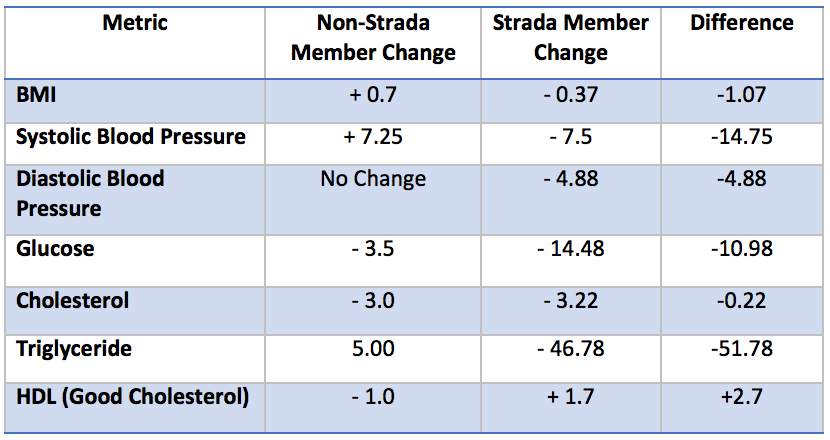

Within just 6 months, Strada members have seen health improvements. Blood pressure, blood glucose, cholesterol, and body mass index all demonstrate improvement. Triglycerides were drastically reduced, which illustrates early success of long-term preventative medicine. High triglyceride levels foretell various health conditions such as: heart disease, stroke, obesity, metabolic syndrome, high blood pressure, diabetes, and liver or kidney disease, among others.

Other notable statistics:

53% of Burton employees and dependents utilized Strada’s virtual care services.

In the first 9 months, 85.5% of care provided by Strada was via virtual communication.

57% of virtual communication was provided by Strada during non-business hours.

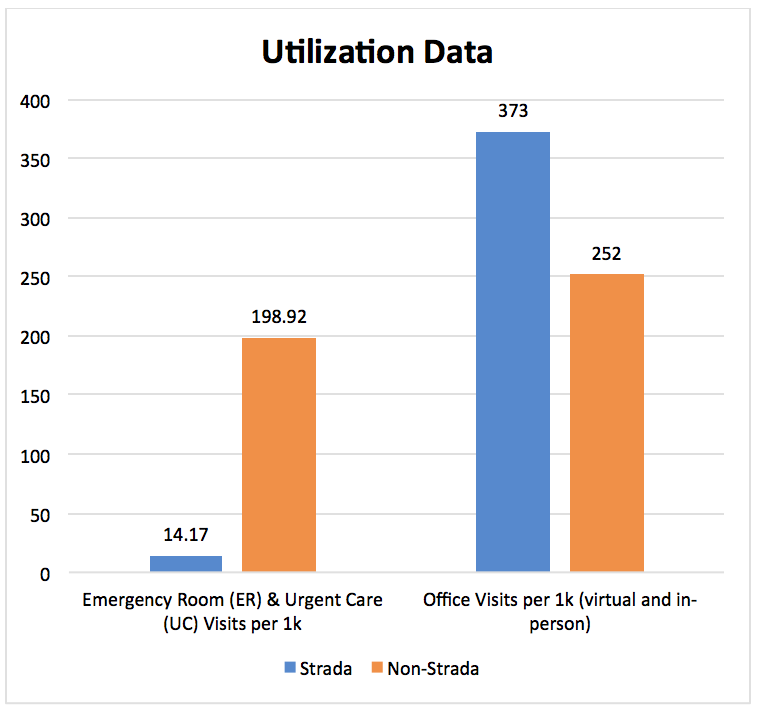
Such proficient use of virtual care via text messaging, picture messaging, phone, and e-mail saves time and hassle, and helps prevent unnecessary Emergency Room and Urgent Care visits.

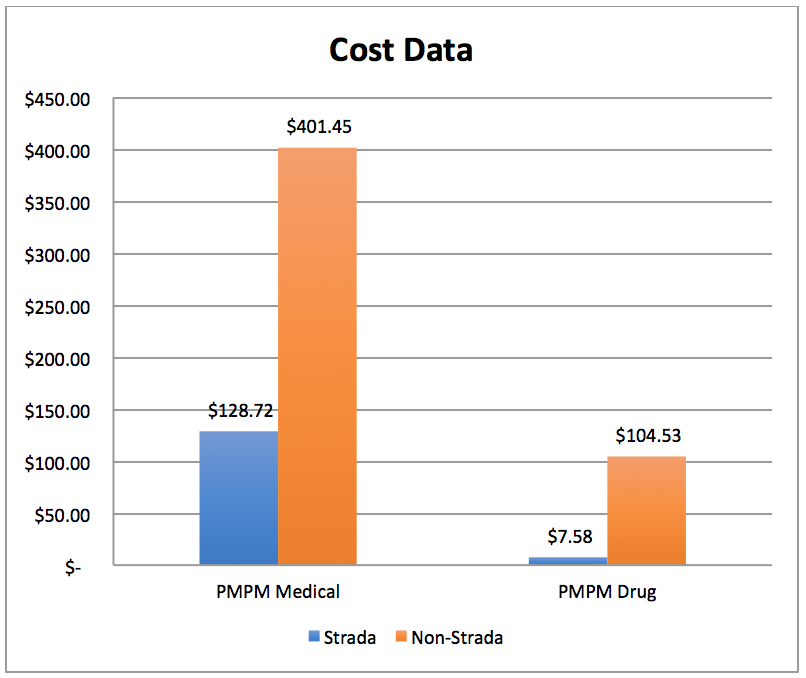
The difference is clear. Strada Healthcare increases access, improves employee health, lowers costs, and reduces ER & UC visits.

Workers Compensation:

After Burton Plumbing implemented Strada, reported worker injuries dropped from 2.6/month to .6/month. Average workers compensation claims dropped from $7887 to $431, and total workers compensation costs dropped from $102,534.54 to $1,295.67.

What customers say:

  • I have a personal relationship with my provider rather than being a number.
  • Access to healthcare is no longer an inconvenience.
  • I enjoy having access to my provider via text messaging and next day appointments.
  • I don’t pay copays.

Supporting Research:

Research has shown time and again that patient-provider partnerships and increased access to a consistent source of care in a timely manner improves health outcomes, and reduces specialist visits, tests, hospitalization, emergency department use, and overall costs (3, 4, 5, 6).

During a 5-year longitudinal study, personalized primary care reduced hospitalization by up to 62% when compared to the control group, and lead to an overall 72% reduction in hospitalization. Patients were 97% less likely to be readmitted for heart attacks, 95% less likely to be readmitted for congestive heart failure, and 91% less likely to be readmitted for pneumonia (7). Meanwhile, researchers in Washington witnessed a 46% decrease in Emergency Room utilization coupled with a 48% reduction in inpatient encounters for DPC patients (8).

Impact to Providers:

In the traditional health care model, providers spend 3.5 hours per week on insurance activity, while nursing staff spend 4 hours per day and clerical staff spend 7 hours per day, per provider (9, 10). With Strada, providers and the care team can focus on patients, not insurance, which increases quality of care, patient satisfaction, and provider satisfaction.


References:

  1. Jiwani, A., Himmelstein, D., Woolhandler, S., & Kahn, J. G. (2014). Billing and insurance-related administrative costs in United States’ health care: synthesis of micro-costing evidence. BMC Health Services Research,14(1). doi:10.1186/s12913-014-0556-7
  2. Kaiser Family Foundation. (2017, March 20). 2016 Employer Health Benefits Survey – Section One: Cost of Health Insurance. Retrieved July 24, 2017, from http://www.kff.org/report-section/ehbs-2016-section-one-cost-of-health-insurance/
  3. Bertakis, K. D., & Azari, R. (2011). Patient-Centered Care is Associated with Decreased Health Care Utilization. The Journal of the American Board of Family Medicine,24(3), 229-239. doi:10.3122/jabfm.2011.03.100170
  4. Petterson, S. M., Rabin, D., Phillips, R. J., Bazemore, A. W., & Dodoo, M. S. (2009). Having a usual source of care reduces ED visits. American Family Physician, 79(2), 94.
  5. Shi, L. (2012). The impact of primary care: a focused review. Scientifica, 2012432892. doi:10.6064/2012/432892
  6. Uscher-Pines, L., Pines, J., Kellermann, A., Gillen, E., & Mehrotra, A. (2013). Emergency department visits for nonurgent conditions: systematic literature review. The American Journal of            Managed Care, 19(1), 47-59.
  1. Klemes, A., Seligmann, R., Allen, L., Kubica, M., Warth, K., & Kaminetsky, B. (2012). Personalized Preventive Care Leads to Significant Reductions in Hospital Utilization. The American Journal of Managed Care,18(12), 453-460. Retrieved from http://www.ajmc.com/journals/issue/2012/2012-12-vol18-n12/personalized-preventive-care-leads-to-significant-reductions-in-hospital-utilization/P-1
  2. Degnin, C. (2015). The Influence of providing primary care to and uninsured population in Clark County, Washington, is associated with reduced utilization of emergency department and inpatient services. Scholar Archive. 3662. http://digitalcommons.ohsu.edu/etd/3662
  3. Casalino, L. P., Nicholson, S., Gans, D. N., Hammons, T., Morra, D., Karrison, T., & Levinson, W. (2009). What Does It Cost Physician Practices to Interact with Health Insurance Plans?. Health Affairs, 28w533-w543. doi:10.1377/hlthaff.28.4.w533
  4. Morra, D., Nicholson, S., Levinson, W., Gans, D. N., Hammons, T., & Casalino, L. P. (2011). US physician practices versus Canadians: spending nearly four times as much money interacting with payers. Health Affairs (Project Hope), 30(8), 1443-1450. doi:10.1377/hlthaff.2010.0893


Rosencrantz & Guildenstern Are Still In The Waiting Room

There is something rotten in the state of medicine, especially family medicine. Merritt Hawkins has recently reported that the average wait time for an appointment with a family physician is 29.5 days. That’s almost an entire month of waiting. A month in between when you, or your child, need to be seen and when the physician can see you. Direct Primary Care is changing that number.

Direct Primary Care, provided by Strada Healthcare in Nebraska and Iowa, is a clinic model that accepts a low monthly membership fee instead of insurance for medications and routine visits. The fee covers most of what the average patient needs, including physicals, labs, and prescriptions at a much lower cost. DPC offers same-day visits with your provider; that is direct access 29.5 days faster than the average physician. This could includes a face-to-face visit with your physician, talking through FaceTime, or taking an emergency trip to the clinic to get stitches after a late night hide-and-seek accident.

DPC is the future of family practice medicine. In the Midwest, there was a waiting span 153 days to 7 days before a physician was available. Not one city surveyed had an appointment available in less than a week. If even one DPC clinic had been called, the patient would have been seen that very day. DPC was created for the families who are frustrated with the cost of copays and urgent-care visits. It was created for people who are busy and don’t have time to waste waiting for a month to wait in a room to see a physician for 5 minutes. Because DPC does not accept insurance, there are no copays, fewer urgent-care visits, and there is less waiting. So alas, while poor Yorick may be waiting for a month to get seen by his physician, you can sign up with DPC today, get your family in and out, and be on your way.


Sources:

Article 1: http://www.mdedge.com/familypracticenews/article/135202/practice-management/wait-times-family-physician-visits-almost-10

Article 2: http://www.businessinsider.com/direct-primary-care-a-no-insurance-healthcare-model-2017-3

Iowa’s Last Insurance Exchange Hope and the Future of Healthcare

By Justin Horn, CSFS

Another example of the drama playing out with America’s health insurance system is in Iowa’s individual health insurance exchange.  That state has seen insurance carriers dropping out like flies.  Within a few days earlier this year both Aetna and Wellmark Blue Cross announced they would not be offering plans in 2018.  This was a rather ominous sign for the nearly 90,000 Iowans covered in the individual market.  Before that in late 2016 the first to do so, United Healthcare, announced it too was dropping out the exchange, sighting massive losses.  A lone insurer, relatively small among the bigger players, Medica, is the last remaining carrier that has submitted premium rates for 2018.  Even so, without Congressional support, Medica has indicated that it too will succumb to industry pressure and could potentially still withdraw. 

The Minnesota based non-profit – Medica, it’s decision, while admirable – stating adherence to its mantra of social responsibility, comes with a high price.  The average increase among products that were filed with the State of Iowa Insurance Commissioner is 43.5 percent.  Subsidies for individuals will likely keep pace with this increase, however, for the roughly 20 percent not eligible for subsidies the renewing plans will come with sticker shock.  Additionally, Medica must plan for the influx of roughly 72,000 new policyholders coming onto its system; not a small task in a short period of time. 

Other nearby states, including Nebraska, are watching the situation unfold and see potential implications of Iowa becoming the first state in the U.S. without a single carrier in the individual health market.  This assumes Congress fails to pass a stop-gap measure, or a full reform bill, that would otherwise keep Medica in the game.  With Medica’s decision hinging on Congress, individual insureds are bracing for impact. 

With the state of the exchange situation in Iowa being extremely dire, the remainder of the population in Iowa obtains coverage through employer sponsored health plans which are also governed by the Affordable Care Act, affording these employees certain coverage minimums and cost sharing caps.  These insureds who get coverage through work continue to wonder what the future might look like for their plans. 

The primary concern among policy experts and industry consultants is what may happen to employer plans if a reform effort wipes away subsidies, removes mandates and/or incentives to keep healthy people in the market, or otherwise makes it easy for employers to drop plans.  The issue facing employers is of course rising costs.  But while most employers and insureds alike are blaming insurance for the crisis, others are letting insurance do what it does best – cover catastrophic situations and using good old-fashioned ingenuity to hold smaller more routine costs at bay. 

Many employers, as well as individuals buying insurance through an exchange in Iowa and Nebraska are turning to a concept called Direct Primary Care, or DPC.  DPC is a membership based access point to unlimited primary care and many secondary and related service areas.  Similar in concept to joining a gym, members pay a set monthly fee and in return receive direct access to their own healthcare team.  Through a HIPAA compliant smart phone app, members can schedule appointments, consult with their physician team, send pictures, even “see” their doctor in a virtual setting.  Individuals are seeing improved biometric levels and improved health, and employers are seeing results in the form of lower plan utilization which is leading to lower cost health plan renewals.  Since DPC is cash based, not insurance, the insurance carriers are not funding those services that would otherwise hit the plan as a claim.  This, in turn, allows both individuals and employers to work together to access care in a smarter more cost-effective way.  White papers and studies are expected to be produced later this summer that will illustrate the cost saving potential and improved overall health of insured populations.  From there, insurance plans will take on a new form, looking more like auto or homeowner’s insurance.  Those types of insurance exist to pay for catastrophic events, leaving choice and competition among service providers.   

In Iowa, individual health insurance customers must wait and see the outcome of Congressional action later this summer.  Whatever happens will invariably change lives and set the tone for 2018 and beyond. 

High-Tech Apps and Old-Fashioned Caring

By Lisa Fisher, MHA, RN

What we introduced as cutting-edge and convenient has proven to us to be an asset in ways we never even imagined. Many times an appointment with a provider is loaded with information…..test results, diagnoses, action plans, medication changes, etc. Strada patients can utilize the Spruce app to connect with their provider to ask any follow-up questions or reaffirm their instructions regarding treatment plans and/or medication. Over 80% of Strada patients are utilizing the Spruce communication tool with text, email, pictures, and video. Healthcare on their time!

Many adults recall when healthcare always involved a relationship with a Primary Care Physician.   Young adults desire to establish an ongoing relationship with a Primary Care Physician. Our providers are able to leverage this technology to build better relationships with Strada patients and deliver an improved standard of care—regardless of the patient’s age.

While answers, advice, and appointments can admittedly be handled through technology, Strada would never undervalue its most important asset – the human intelligence, education, and training of our providers. Face-to-face appointments are necessary and our providers are thoroughly enjoying getting to practice “old-fashioned” medicine where appointment times are unrushed, relationships are formed, and trust is established.


The Importance of a Healthy Lifestyle

By Don Scarborough, MS, PA-C

Every food, drink, stress, cigarette, physical activity, or lack thereof, leads each of us toward health or disease.  Often, we put highly addictive, processed food in our mouth that looks and acts nothing like the food of our ancestors.  The food of our ancestors was whole food, grown and raised on a farm or in the back yard, it came from the earth and was the majority of calories consumed.  They would expend many calories to grow food, hunt, gather, and prepare their food daily and were thus extremely physically active.  

Our society is now dependent on large amounts of highly concentrated foods with added sugar, sodium, fat and flour in most items found in grocery stores.  The average American‘s sugar consumption has tripled over the last 50 years. At the same time, the CDC estimates that nearly 80% of adult Americans do not get the recommended amount of exercise of 2.5 hours each week.  This combination of highly addictive food with minimal to no physical activity is leading to an epidemic of obesity, heart disease, cancer, high blood pressure and strokes, which are among the leading causes of death in the USA.

For example, we can go through a drive-up window, expend approximately 7 calories to hand over money to grab 1,500 to 2,000 calories in high sodium, high sugar and high fat food.  So that’s 1,493 to 1,993 calories in excess filling our fat stores or raising our blood sugar.  Compare that amount of processed food with minimal fiber entering our body and blood stream vs whole food loaded with high octane nutrition that releases slowly into our system while adding fluid, vitamins, minerals and fiber.  

Therefore, if we are going to impact our health it is going to have to be through proper diet, dealing with food addiction, physical exercise, spending time outside and coping with daily stressors.

“If someone wishes for good health, one must first ask oneself if he/she is ready to do away with the reasons for his/her illness.  Only then is it possible to help them.” Hippocrates approximately 300 BC 

Strada Healthcare providers will help you navigate through the stress, nutrition and exercise routines to give you optimum health for disease prevention.  We have time to visit with you, establish a plan and make you a happier, healthier you.

DPC: Building and Accelerating Analytics Infrastructure

By Vineeth Yeddula, CLSSMBB, PMP, CMQ, OE and Michael Hein, MD, MS, MHCM, FACP

Background

Healthcare in the US is undergoing major transformation. These changes are driven from multiple fronts, including employers, customers, payers, regulations, and policy changes. It is a dynamic environment that has created uncertainty and a great deal of opportunity.

One response to these changes has been a substantial increase in the administrative burden upon primary care practices. These changes have added financial pressures as providers encounter flat or decreasing reimbursement under the traditional fee-for-service environment.

The independent primary care practice market has responded to these changes in two main ways: employment, usually by hospital-based systems, or movement towards a subscription-based practice model which disintermediates the payors. The later has been called: Direct Primary Care (DPC).

Analytic Needs of DPC

While some DPC practices are formed to escape the required reporting by payors of cost, quality and experience metrics, a time and labor-intensive burden for independent practices, other DPC practices have recognized that they now are in direct competition with traditional practice. To compete in their markets for members, DPC needs to be able to create a compelling story shared with employers and potential members. The story needs to show why DPC is a superior option and that story is written with data. Unfortunately, many DPC practices lack basic data acquisition, aggregation, analysis, and reporting capabilities.

To maintain a competitive edge, DPC not only needs better access to data, they must also infuse their practices with a culture of continuous performance improvement. An activity that can only occur with access to reasonably accurate, timely, actionable data that has been converted so it creates knowledge in the hands of clinicians so compelling that change in care processes becomes an imperative. The combination of actionable data and performance improvement science deployed in a DPC practice will empower DPC practices to continuously demonstrate their superior value proposition in the market. 

Strada Healthcare’s Partnership with KPI Ninja

Strada is the largest DPC company in Nebraska. Early in its development, Strada recognized the need to build an analytics infrastructure so that they could demonstrate lower cost, higher quality, better patient experience, and lower utilization of healthcare services compared to the traditional model.

To accelerate their capability Strada engaged KPI Ninja, a leader in healthcare analytics and performance improvement.

KPI Ninja integrates several disparate data sources into an Enterprise Data Lake, which is no easy task since the data is often dated, retrospective, and of questionable validity. KPI Ninja uses various means, including Big Data platforms and machine learning to make sense of the mess, and then delivers a cohesive picture (reporting), painted by data (advanced analytics), to its clients.

Through these keen insights coming from several disparate data sources, Strada is planning to utilize this information and approach employers to make a compelling story around the care it is providing to its patients – Personal, Affordable, Accessible Healthcare.

About KPI Ninja

KPI Ninja is a healthcare technology and consulting company. Our mission is to accelerate the Quality, Safety, and Performance Improvement culture in preparation for a value based world. The KPI Ninja team are healthcare leaders who have deep experience in successfully deploying analytics and performance improvement programs within multiple organizations and have helped create the kind of culture necessary to be an organization known for their continuous improvements in quality, cost, safety and experience.

About Authors

Michael Hein, MD, MS, MHCM, FACP: Co-founder, Co-owner. More than 20 years of healthcare and healthcare leadership experience, inclusive of leading large-scale strategic initiatives, performance improvement management, and practice transformation. Provides strategic and clinical direction and oversight.

Vineeth Yeddula, CLSSMBB, PMP, CMQ OE: Co-founder, Co-owner. An entrepreneur and engineer by training with significant health care data analytics and performance improvement experience in multiple healthcare settings. Provides strategic and tactical direction, oversees all data and improvement strategic and tactical deployment.